
Design Guidelines
There are two primary things you want to mitigate when designing a part for injection molding: tooling (mold) cost, and sink or warp in the finished part. An injection mold can be built in almost any configuration desired, but that does not always mean it is cost-effective or that the tool will yield the part as-designed.
Injection molding part performance is largely determined by early design decisions. Wall thickness, draft, geometry, material selection, and tolerance strategy within the larger assembly all directly influence mold complexity, part stability, cosmetic quality, and long-term cost. Addressing these factors during design is far more effective and cost-efficient than attempting to correct them after tooling begins.
Shrink, Warp, and Why Geometry Matters
The moment molten plastic enters the mold, it begins to shrink—and it will not do so uniformly unless controlled. This is how molded parts become warped or develop sink marks.
Shrink behavior varies based on the specific material chosen (for which most material manufacturers provide technical guidance), and is further influenced by wall thickness consistency, flow direction, cooling, and overall geometry.
Uneven shrink and inconsistent cooling are the root causes of most warp and sink issues. While tooling and process adjustments can help mitigate these, sound part design remains the primary control mechanism.
The good news is that Eck Plastics has you covered. Our expert engineering staff can guide you on how your part can be designed to reduce costs and create high-quality, uniform parts—while still meeting your functional requirements. Below are some general guidelines.
These guidelines reflect real-world production experience and are intended to help engineers design parts that mold consistently, meet functional requirements, and avoid unnecessary redesign, cost, and delay.
Have questions about how shrink or warp may affect your specific design?
Talk to an Eck Plastics engineer to review your part early in the design process.
Draft
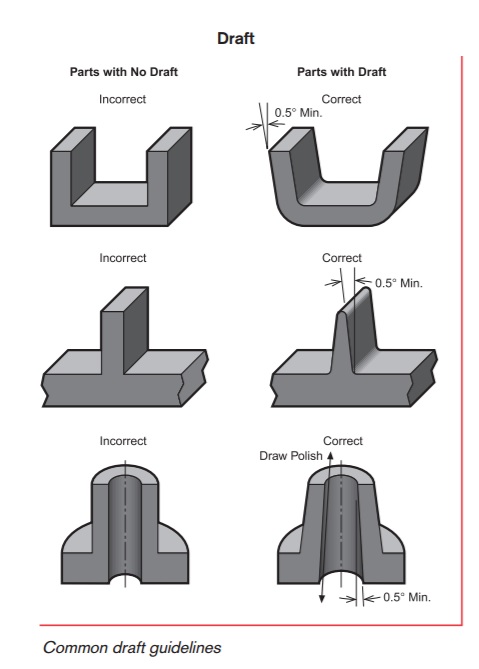
To prevent parts from being damaged during ejection from the mold, a taper called draft is applied to part faces that are parallel to the direction of mold opening. Recommended draft guidelines include:
- Draft all surfaces parallel to the direction of mold separation.
- Angled walls and features formed partially in both mold halves assist ejection and help maintain uniform wall thickness.
- As a general rule, use one degree of draft plus one additional degree for every 0.001 inch of texture depth.
- Use a draft angle of at least one-half degree for most materials. Where design permits, one degree or more of draft is recommended for easier ejection. SAN resins typically require one to two degrees of draft. Material-specific recommendations should always be reviewed during material selection.
- The deeper the part being drafted, the more draft it should have.
Draft should be incorporated into the initial design rather than treated as a secondary adjustment. Adding draft after the geometry is finalized often impacts functional or cosmetic surfaces and can create conflicts with mating components.
From a CAD perspective, it is typically easier to apply draft to exterior geometry first and then shell the part to achieve uniform wall thickness rather than the reverse.
Coring & Wall Thickness
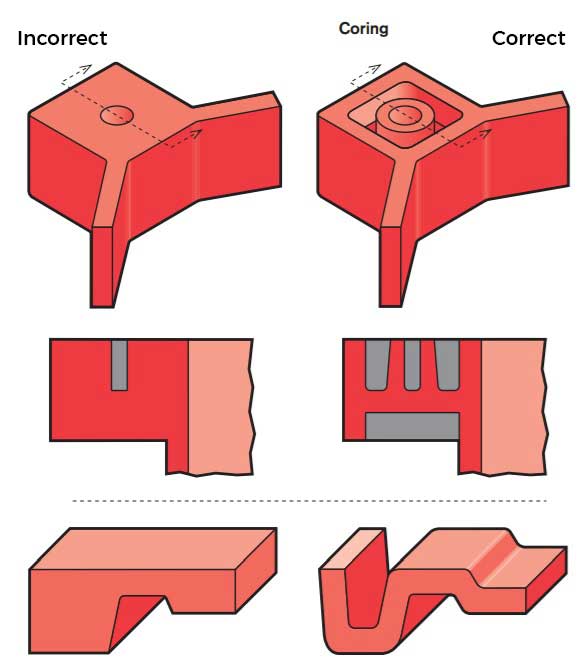
Parts that are too thick can result in warping and sink marks due to inconsistent cooling. By shelling out thick areas, a more uniform part can be achieved while also reducing material costs. Part rigidity and functional strength can still be maintained through the use of internal ribs.
Sink marks and warpage are best avoided by designing parts with uniform wall thicknesses.
Maintaining consistent wall thickness is one of the most important factors in controlling shrink, warp, and cycle time. Abrupt transitions (transitions without fillets or chamfers), isolated thick sections, or unnecessary mass drive cosmetic defects and may increase cooling time. While ribs and gussets can restore stiffness, they must be sized and located carefully to avoid secondary sink or warp issues.
To achieve optimal results, Eck Plastics recommends using the wall thicknesses listed below:
| Resin / Material | Inches |
|---|---|
| ABS | 0.045 - 0.140 |
| Acetal | 0.030 - 0.120 |
| Acrylic | 0.025 - 0.500 |
| Liquid Crystal Polymer | 0.030 - 0.120 |
| Long-fiber Reinforced Plastics | 0.075 - 0.150 |
| Nylon | 0.030 - 0.115 |
| PC (Polycarbonate) | 0.040 - 0.150 |
| Polyester | 0.025 - 0.125 |
| Polyethylene | 0.030 - 0.200 |
| Polyphenylene Sulfide | 0.020 - 0.180 |
| Polypropylene | 0.025 - 0.150 |
| Polystyrene | 0.035 - 0.150 |
| Polyurethane | 0.080 - 0.150 |
Unsure if your wall thickness is optimized for molding and cost?
Request a design review before tooling begins.
Tolerances
Industry-wide, tolerances for injection-molded parts vary depending on the polymer used and the overall size and geometry of the part. This is because tolerances rely heavily on a molder’s ability to predict polymer shrinkage as material transitions from liquid to solid—both in the mold and after ejection. This is a challenging endeavor at best.
Injection molding tolerances generally fall into two categories: commercially accepted tolerances and fine tolerances. Commercial tolerances are typically repeatable and economical. Fine tolerances may be achievable but are material- and geometry-dependent and often involve added cost and risk.
Tolerance stack-ups are frequently underestimated. Engaging with the molder early helps identify which dimensions are functionally critical and which can remain commercially accepted. Applying tight tolerances only where necessary can significantly reduce tooling complexity and piece price.
Tolerance also directly impacts pricing during the molding cycle. More restrictive tolerances require tighter process control, longer cycle times, and increased scrap risk. In many cases, molded parts may vary some from nominal dimensions yet still fit, function, and appear as intended.
Below is a chart outlining generally accepted tolerances for the injection molding industry.
| Resin / Material | Tolerances | |
|---|---|---|
| Fine | Commercial | |
| ABS | Plus or minus .003 for the first 1 inch in length plus an additional .001 for every inch thereafter. | Plus or minus .005 for the first inch in length plus .00125 for every inch thereafter |
| Acetal | Plus or minus .005 for the first inch in length plus .00125 for every inch thereafter | Plus or minus .005 for the first inch in length plus .00125 for every inch thereafter |
| Acrylic | Plus or minus .0035 for the first inch in length plus .001 for every inch thereafter | Plus or minus .005 for the first inch in length plus .00125 for every inch thereafter |
| Liquid Crystal Polymer | Plus or minus .005 for the first inch in length plus .00125 for every inch thereafter | Plus or minus .005 for the first inch in length plus .00125 for every inch thereafter |
| Long-fiber Reinforced Plastics | Plus or minus .005 for the first inch in length plus .00125 for every inch thereafter | Plus or minus .005 for the first inch in length plus .00125 for every inch thereafter |
| Nylon | Plus or minus .0025 for the first inch in length plus .00125 for every inch thereafter | Plus or minus .00475 for the first inch in length plus .00125 for every inch thereafter |
| PC (Polycarbonate) | Plus or minus .0025 for the first inch in length plus .00075 for every inch thereafter | Plus or minus .004 for the first inch in length plus .001 for every inch thereafter |
| Polyester | Plus or minus .003 for the first inch in length plus .0006 for every inch thereafter | Plus or minus .004 for the first inch in length plus .00125 for every inch thereafter |
| Polyethylene | Plus or minus .00425 for the first inch in length plus .0015 for every inch thereafter | Plus or minus .007 for the first inch in length plus .002 for every inch thereafter |
| Polyphenylene Sulfide | Plus or minus .005 for the first inch in length plus .00125 for every inch thereafter | Plus or minus .005 for the first inch in length plus .00125 for every inch thereafter |
| Polypropylene | Plus or minus .00425 for the first inch in length plus .00125 for every inch thereafter | Plus or minus .007 for the first inch in length plus .002 for every inch thereafter |
| Polystyrene | Plus or minus .003 for the first inch in length plus .00075 for every inch thereafter | Plus or minus .0045 for the first inch in length plus .00125 for every inch thereafter |
| Polyurethane | Plus or minus .005 for the first inch in length plus .00125 for every inch thereafter | Plus or minus .005 for the first inch in length plus .00125 for every inch thereafter |
Corner Design
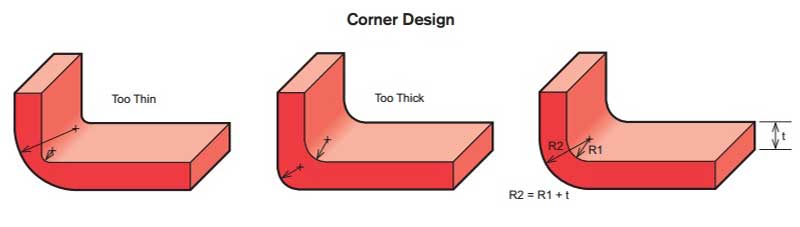
Good corner design is critical in injection-molded parts for several reasons. Properly designed corners distribute stress more evenly, reducing weak points that can lead to warping or cracking in assembled parts. Sharp corners create stress concentrations and restrict material flow, increasing the risk of defects such as short shots.
Generous radii improve material flow, reduce molded-in stress, and enhance cosmetic consistency. From a tooling perspective, sharp internal corners are difficult to machine and accelerate tool wear, while radiused geometry improves manufacturability and tool longevity.
Thickness Transitions
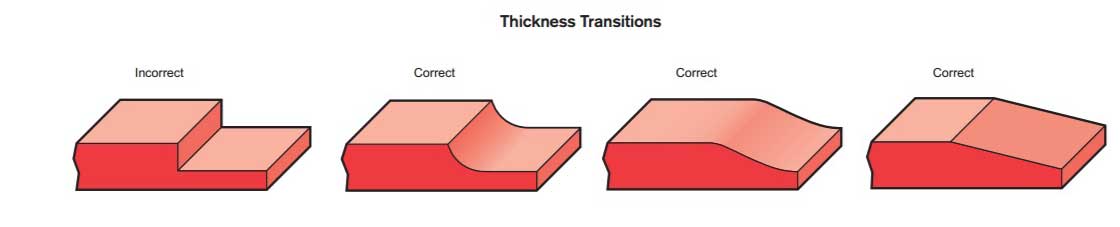
By rounding or tapering transitions in part thickness, read-through and similar surface blemishes can be minimized. Gradual transitions also reduce molded-in stress and stress concentration associated with abrupt thickness changes.
Abrupt transitions are a common source of sink, warp, and other cosmetic defects. Controlled transitions allow material to both flow and cool more uniformly, improving dimensional stability and part quality.
Ribs
Ribs reinforce strength and stiffness in molded parts without increasing the overall nominal wall thickness. Proper rib design considers five main criteria: thickness, height, location, quantity, and moldability.
Additional uses for ribs include:
- Acting as stops or guides for mechanisms
- Locating and capturing components within an assembly
- Providing alignment in mating parts
While ribs are effective, overuse can create cooling challenges and lead to warpage. Ribs are typically easier to add than remove, so they should be applied conservatively in early designs and added incrementally as needed.
Rib Thickness
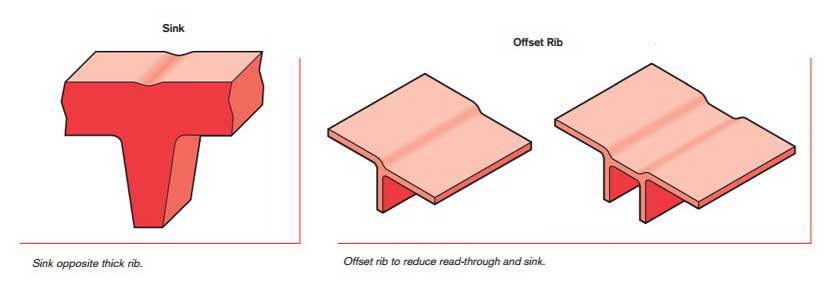
Rib thickness plays a major role in cosmetic and structural performance. Overly thick ribs can cause sink marks on the opposite wall surface. Factors relating to rib design that influence sink severity include: rib thickness, surface texture, color, gate proximity, and processing conditions.

Rib Location & Quantity
Careful consideration should be given to rib placement and quantity. For example, ribs added to prevent breakage under a sustained load may reduce impact resistance. Similarly, dense rib grids intended to ensure flatness can introduce mold-cooling challenges and warpage.
Ribs are much easier to add than remove, so they should be applied sparingly in the initial design and refined during validation. Excessive ribbing can also increase cooling time, reducing the yield in parts per hour and impacting piece price.
Bosses
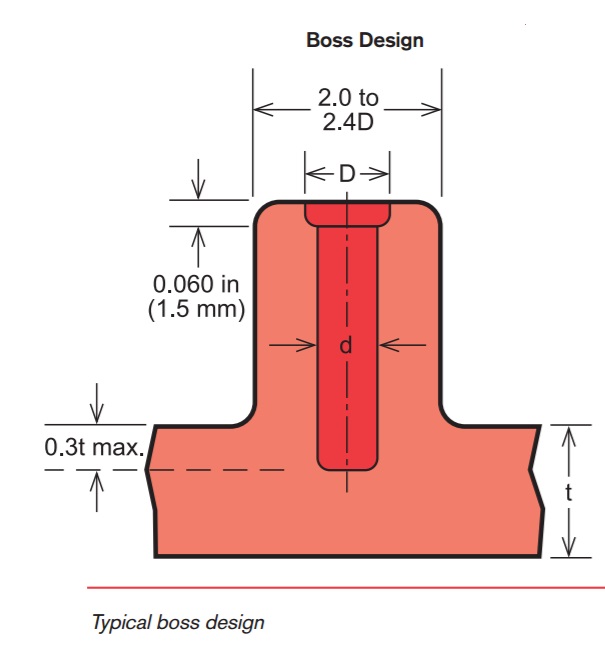
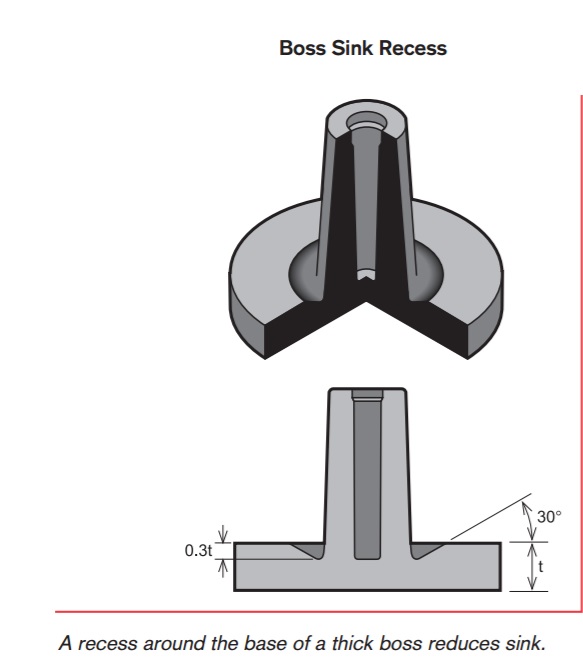
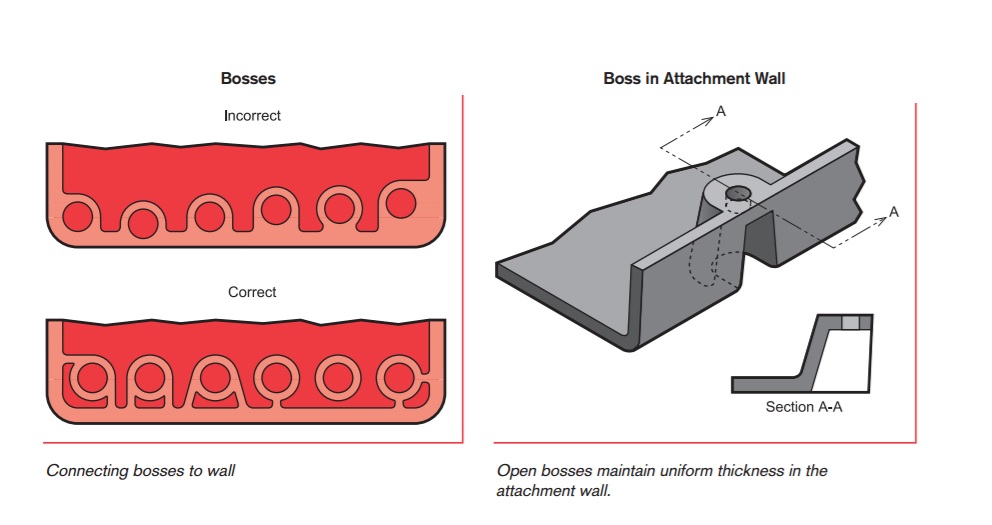
Bosses are projections typically designed to facilitate alignment, or enable fastening. The most common type is a cylindrical projection with a hole for screws or threaded inserts.
A general design rule is that the outside diameter of a boss should be 2.0 to 2.4 times the outside diameter of the screw or insert. Bosses should not merge directly into sidewalls, as this creates thick sections that can lead to sink on the visible surface of the part. If it is necessary to place a boss near a side wall and additional strength is needed, that boss should be spaced away and joined to it with a properly designed rib. In corners, two ribs are typical (one to each wall forming the corner.)
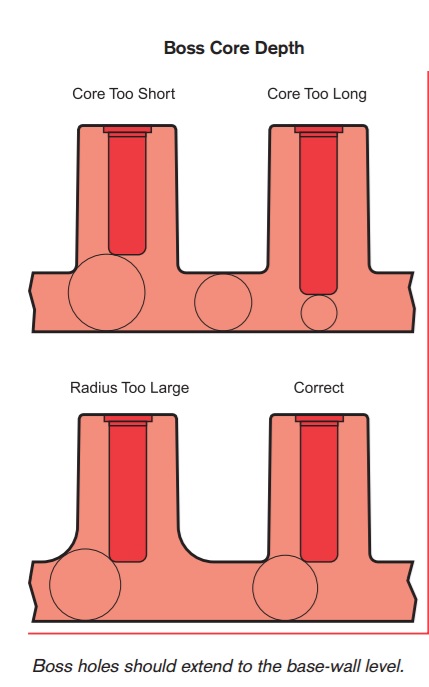
The boss’ center hole should extend to the level of the part’s nominal wall, even if that full depth is not required for the chosen fastener. Shallow holes leave thick sections that increase the risk of sink, while overly deep holes can reduce nominal wall thickness, potentially causing filling issues, knit lines, or surface blemishes.
Because of draft requirements, tall bosses (greater than five times their outside diameter) may cause filling issues at the top or thick sections at the base. Tall cores can also be difficult to cool and support. Consider coring tall bosses from two sides (creating a hole through the part) or using gussets to achieve the required standoff height rather than extending the full boss.
Boss design benefits significantly from early review. Small geometry changes can minimize or eliminate sink, simplify tooling, and improve throughput. In many cases, alternative fastening strategies or gusseted designs achieve the same functional outcome with less material and shorter cycle times.
Designing a new part or refining an existing one?
Contact Eck Plastics to review your design before tooling and avoid costly revisions.

Injection Molding
Process that creates plastic objects by injecting molten plastic into a mold
Injection Molding
Process that creates plastic objects by injecting molten plastic into a mold

Thermoforming
Process of heating a thermoplastic sheet and applying a force to form it into or over a mold
Thermoforming
Process of heating a thermoplastic sheet and applying a force to form it into or over a mold

Plastic Fabrication
From advice on how to design for manufacturing, or assembly of plastic products
Plastic Fabrication
From advice on how to design for manufacturing, or assembly of plastic products

Product Finishing Operations
Delivering quality plastic parts may require more, and Eck Plastic Arts is ready to complete your project!
Product Finishing Operations
Delivering quality plastic parts may require more, and Eck Plastic Arts is ready to complete your project!
The Eck Plastic Arts Partnership Promise:
Hire and train good PEOPLE. Execute precise PROCESSES. Deliver quality PARTS.
We believe through our quality PEOPLE and the focus on continually improved PROCESSES we deliver the highest quality plastic PARTS ensuring your confidence in a long-term partnership.

Ready TO WORK WITH ECK Plastic Arts
We believe through our quality PEOPLE and the focus on continually improved PROCESSES we deliver the highest quality plastic PARTS ensuring your confidence in a long-term partnership.